If your monthly allowance from home disappears before the 20th of the month, you do not have an income problem—you have a pacing problem. Most money management tips for students focus on cutting out coffee or downloading complex expense trackers that nobody updates after day four. When you live in an Indian college hostel or PG, you need a system built for a fixed lump-sum allowance and instant UPI spending.
This guide breaks down a practical week-by-week pacing method, an illustrative ₹6,000 monthly allowance plan, clear explanations of popular budgeting rules, and realistic steps to recover when an unexpected expense hits mid-month.
Why Hostel and PG Allowances Disappear Before Week 3
Cash used to act as a natural speed bump: when you opened your wallet and saw only two ₹500 notes left, you automatically slowed down. Today, digital payments remove that friction completely. According to the NPCI official UPI overview, Unified Payments Interface enables 24/7 instant bank-to-bank transfers, QR code merchant payments, and AutoPay mandates for recurring bills. That convenience is great for paying an auto driver or splitting a dinner bill, but it also makes twenty ₹80 transactions feel invisible until your bank balance drops below ₹500.
Three patterns drain student allowances fastest:
- Front-loading in Week 1: Right after the allowance arrives, it is easy to clear pending wants, order food online, and say yes to every outing.
- Unrecorded split bills: Paying for a group order and forgetting to follow up on ₹150–₹300 shares from friends.
- Silent recurring charges: Streaming subscriptions, cloud storage, or OTT trials set on AutoPay that renew quietly every month.
The Week-by-Week Allowance Pacing Method
Trying to stretch one lump sum across 30 days rarely works because the human brain is bad at judging monthly runway. Instead, split your allowance into three parts the day it lands in your account:
- Fixed essentials (Day 1): Pay or set aside non-negotiable monthly items immediately—mobile data pack, laundry, printouts, or shared PG utilities.
- Emergency buffer (10%): Keep 10% untouched for genuine surprises like pharmacy visits, urgent lab materials, or last-minute travel.
- Four weekly buckets: Divide whatever remains by 4.3 (or simply by 4, leaving the extra two days covered by your buffer). That number is your hard cap from Monday to Sunday.
Illustrative Example: Pacing a ₹6,000 Monthly Allowance
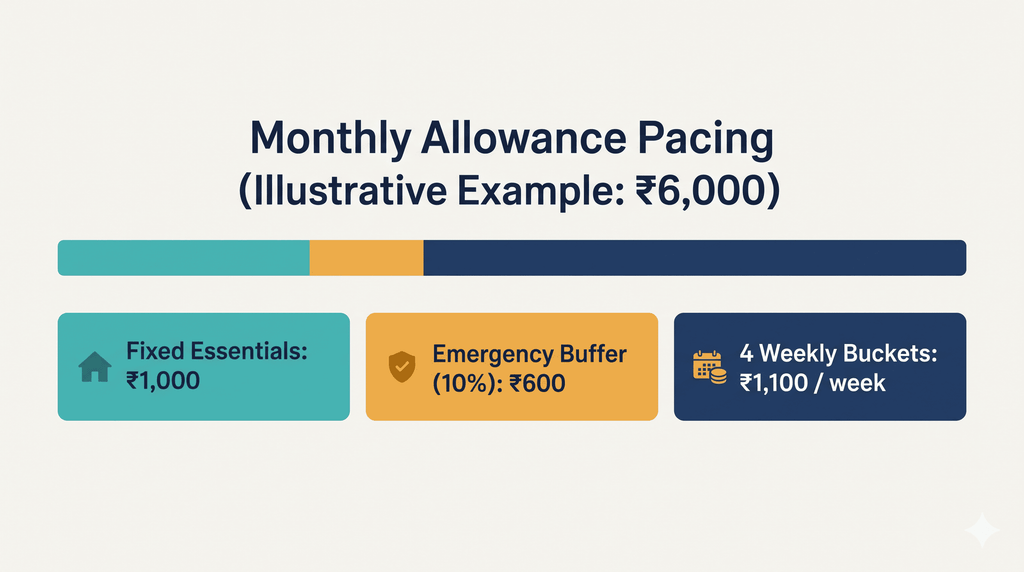
(Note: The breakdown below is an illustrative example for a hostel student whose mess and room rent are already paid separately. Adjust the figures to match your city and actual allowance.)
- Fixed essentials (set aside on Day 1): ₹1,000 (mobile recharge ₹300, laundry/toiletries ₹450, academic printouts/stationery ₹250)
- Emergency & savings buffer (10%): ₹600
- Remaining spendable allowance: ₹4,400 → ₹1,100 per week across 4 weeks (covering canteen snacks, coffee, local transport, and weekend outings)
If you spend only ₹900 in Week 1, roll the leftover ₹200 into Week 2 or add it to your buffer. If you hit ₹1,100 by Friday evening, you switch to zero-spend hostel mode (mess food only) until Monday morning. That short 48-hour reset is much easier to handle than running completely dry for the final ten days of the month.
5 Practical Money Management Tips for Students in India
Once your weekly ceiling is set, five small habits keep you inside it without feeling restricted:
1. Use UPI Lite or a Secondary Account for Daily Scans
Keep your main allowance in your primary bank account and load only one week’s budget (for example, ₹1,100 in our illustrative example) into UPI Lite or a secondary zero-balance student account. When that wallet hits zero, you physically cannot overspend without deliberately transferring more money—bringing back the “empty wallet” speed bump.
2. Settle Group Splits Within 24 Hours
Whether it is a birthday cake, cab fare, or late-night food delivery, send the UPI request the same evening. Waiting until the end of the week makes everyone forget exact amounts, and small ₹100–₹200 gaps quietly eat into your own weekly limit.
3. Audit Your Subscriptions Every Semester
Open your UPI app’s AutoPay / Mandates section once at the start of every semester. Cancel any music, OTT, or app trial you have not actively used in the last two weeks.
4. Apply the 24-Hour Rule to Non-Essential Purchases
For any unplanned purchase above ₹500 (gadgets, sneakers, headphones, or online sale items), add it to your cart and wait 24 hours. Half the time, the impulse fades by the next afternoon.
5. Do a 5-Minute Sunday Balance Check
Every Sunday night, check your bank balance and compare it against how many weeks remain in the month. You do not need to log every ₹20 tea—just knowing whether you are ahead of or behind schedule is enough to course-correct early.
For a quick summary of this framework, see our pocket money management homepage.
Popular Budgeting Rules Explained
When students search for budgeting advice online, three classic rules show up repeatedly. Here is how each works and whether it actually fits a college allowance:
What is the 50/30/20 rule for managing money?
The 50/30/20 rule divides your monthly income into 50% needs, 30% wants, and 20% savings. For working adults paying rent and groceries, this is a solid baseline. For hostel students whose parents already pay tuition and mess fees, “needs” are often much smaller than 50%, so a 20% essentials / 60% weekly living / 20% savings-buffer split is usually more realistic.
What is the 70-10-10-10 budget rule?
The 70-10-10-10 rule allocates 70% to living expenses, 10% to savings, 10% to investments or skill-building, and 10% to giving or debt repayment. On a tight student allowance, you can treat the two middle 10% slices as a combined 20% emergency and goal fund (for example, saving for a certification exam or a trip home).
What is the 7-7-7 rule for money?
Online finance posts often use “7-7-7” to describe long-term investing habits or saving benchmarks, though definitions vary by blog. As a student on a fixed allowance, focus on building a reliable 1-month emergency cushion first before worrying about complex investment formulas.
(Note on finding reliable guides: Because personal finance is a sensitive topic where generic advice often crowds out useful local information, publishers who care about SEO and AI search visibility focus on clear structure, transparent examples, and authoritative citations rather than recycled tips.)
What to Do When Your Allowance Runs Out Early
Even with a solid plan, exams, festivals, or a sudden phone repair can throw a month off track. If you hit zero before the 25th:
- Freeze all convenience spending immediately: Pause food delivery apps, paid rides, and café runs; rely on hostel mess meals and campus facilities.
- Avoid instant loan apps and buy-now-pay-later (BNPL) traps: High-interest student loan apps turn a ₹1,000 shortfall into a multi-month headache.
- Be honest with your parents once—with a breakdown: If it is a genuine emergency (medical or academic), share the exact cost rather than asking for a vague top-up, and adjust next month’s buffer accordingly.
Frequently Asked Questions
Is ₹20,000 per month a lot for a college student in India?
It depends entirely on whether rent and food are included. If your hostel and mess fees are paid separately, ₹20,000 is well above average for pocket money alone. If you live in a private PG or shared flat in a metro city like Bengaluru, Mumbai, or Delhi NCR and pay rent, electricity, Wi-Fi, and groceries out of that amount, ₹20,000 can be tight and requires strict weekly tracking.
How can I manage pocket money as a college student without tracking every rupee?
Use the weekly bucket method: transfer only one week’s spendable allowance to a secondary account or UPI Lite wallet every Monday. As long as you stay inside that weekly wallet, you never have to manually log every small purchase.
Want to know who created Monthly Kharcha?
Read more about our student team and editorial approach on our About Monthly Kharcha page.
Leave a Reply